


 by
by 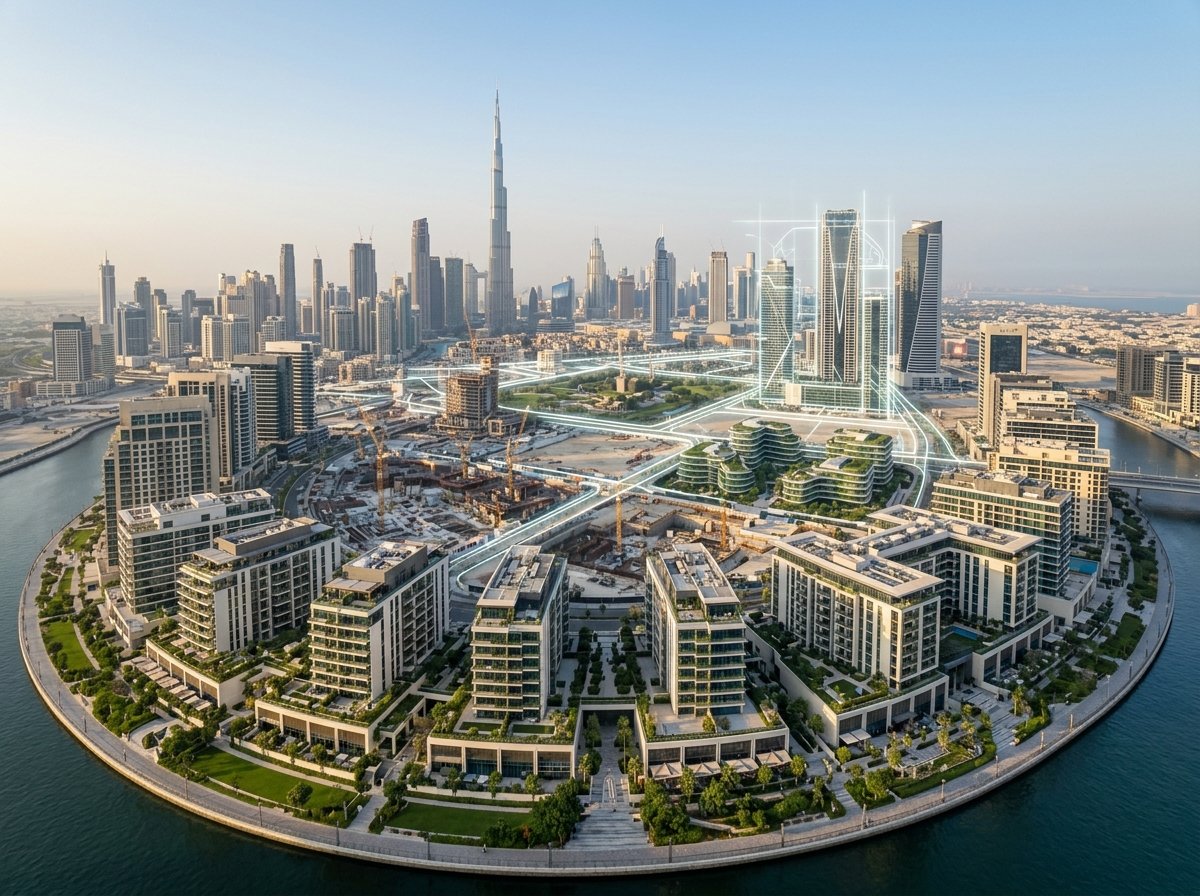
The Dubai 2040 Urban Master Plan isn’t a distant blueprint — it’s a live force already redirecting capital, infrastructure, and demand across the emirate. Here’s what every serious investor needs to understand.
Key Statistics
5.8M — Projected Population by 2040
105% — Increase in Green & Recreation Space
AED 262.7B — Annual Transaction Volume
A City That Builds Its Future on Paper — Then Builds It in Concrete
“Most cities talk about 20-year plans. Dubai has a habit of delivering them in ten.”
Ratified in 2021, the Dubai 2040 Urban Master Plan is arguably the most ambitious single urban policy document the Gulf has ever produced. Its ambition: double green space, concentrate density into five strategic urban centres, preserve nature corridors between them, and absorb a population that the government projects will grow from roughly 3.3 million today to 5.8 million by 2040.
For property buyers, the plan is not a forecast. Infrastructure spending is already flowing. Metro extensions are under design. New residential zones are being rezoned. And developers — both local giants and international capital — are positioning land banks along exactly the corridors the plan identifies. The question isn’t whether the plan will affect values. It’s whether you’re positioned ahead of the shift or behind it.
Understanding the 2040 Plan means understanding its architecture: five distinct urban centres, each with a defined character, a defined density ceiling, and a defined purpose in the metropolitan system. Together, they form an interlocking framework designed to reduce the pressure on the historic core and distribute economic activity — and therefore real estate demand — across the entire emirate.
The Five Urban Centres: Where Dubai’s Growth Is Being Deliberately Directed
Each centre serves a distinct function in the metropolitan hierarchy.
01 — Deira & Bur Dubai
The historic core. The plan calls for sensitive densification and adaptive reuse of heritage assets, supported by Creek enhancements and the expansion of the Gold Souk and cultural quarter. Heritage tourism and long-term apartment demand remain the primary drivers here.
02 — Downtown Dubai & Business Bay
The established global face of the city. Development here is largely mature, but the plan reinforces its primacy as the commercial and luxury hospitality epicentre. Entry prices are high; capital preservation rather than outsized yield is the return profile.
03 — Dubai Marina & JBR
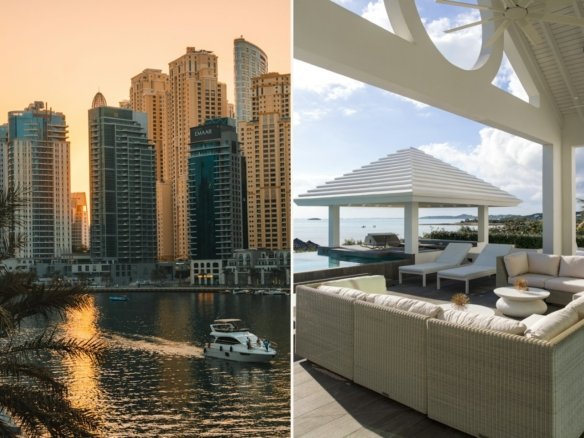
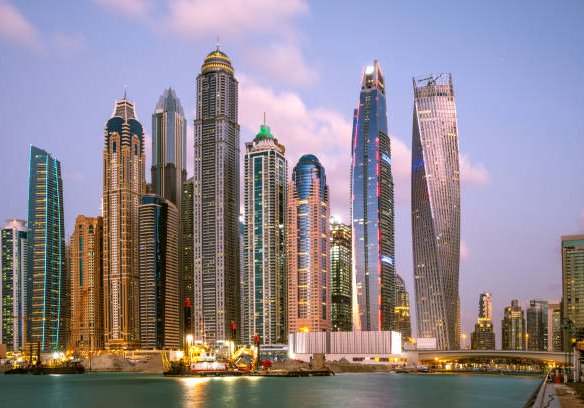
The leisure and residential waterfront. The plan consolidates its role as an international lifestyle destination. Continued infrastructure investment supports rental yields that consistently outperform the city average, driven by sustained expat and tourist demand.
04 — Expo City & Dubai South
The emerging engine. Al Maktoum International Airport expansion — set to eventually handle 260 million passengers annually, making it the world’s largest airport — is the centrepiece. Expo City is evolving into a permanent innovation district. For investors: this is the highest-optionality zone in the plan.
05 — Dubai Creek Harbour & Meydan
The new-generation urban district. Master-planned from scratch, anchored by the Dubai Creek Tower and kilometres of waterfront promenade. Meydan’s infrastructure positioning — near the city’s equestrian and cycling trail network — gives it a lifestyle premium rare at these price points.
Four Property Value Drivers: How the Master Plan Transmits Into Pricing
Urban plans don’t move prices directly. Four mechanisms do.
I. The Green Space Premium
The plan targets a 105% increase in recreational and green areas — from 7.2 sq km today to 14.8 sq km. Properties within 400 metres of major green corridors consistently command a 12–18% price premium globally, and Dubai’s market is catching up to this dynamic. Projects like Dubai Hills Estate and Tilal Al Ghaf — which centre entire communities around parks and trail networks — are already pricing this in.
II. Transit-Driven Appreciation
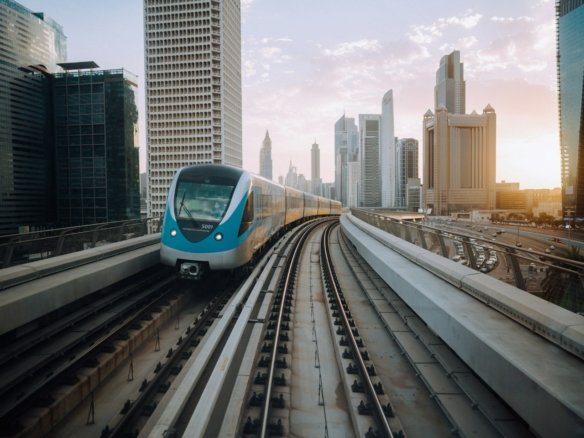
Every major metro expansion in Dubai’s history has been followed by 15–30% appreciation in surrounding residential values within 36 months of announcement. The planned extensions linking Dubai South to the existing Red Line, and the new Blue Line serving new districts, are already in the pricing models of sophisticated buyers. Land near future stations is the most reliable early-entry play.
III. Population Demand Pressure
Adding roughly 2.5 million residents over 14 years requires approximately 125,000–150,000 new housing units — well above current delivery pipelines in the affordable and mid-market segments. JVC, Dubailand, and Dubai South are the logical absorption zones, with entry points from AED 380,000–450,000 making them accessible to the owner-occupier class the government is actively cultivating through the Golden Visa scheme.
IV. Density Caps & Regeneration Uplift
The plan introduces hard density limits in natural and heritage zones while enabling intensification in the five urban centres. This dual mechanism tends to compress supply in constrained areas (generating premiums) while unlocking new supply in regeneration zones at today’s lower land costs. Investors who identify regeneration corridors before zoning changes formalise capture the highest margins.
Investor Timeline: Milestones That Move the Market
Real data points across the planning horizon.
2021 — Master Plan Ratified
Sheikh Mohammed formally approves the 2040 Urban Master Plan, identifying the five urban centres and committing to the green space and infrastructure targets. Early-mover capital begins accumulating in Dubai South and Creek Harbour.
2024–2025 — Al Maktoum Airport Expansion Accelerates
Phase one groundworks confirmed. The first terminal building — eventually designed for 150M+ passengers — enters construction. Land values in Dubai South begin to re-rate. Off-plan launches in the corridor are oversubscribed within days.
2026 — Shared Housing Law & Regulatory Modernisation
New co-living regulations establish occupancy standards and licensing for shared residential units — a signal that Dubai is professionalising its rental market to international standards. Institutional capital responds positively. Rental yields hold above 6.5% city-wide.
2028–2030 — Blue Line Metro & Dubai South Connectivity
Projected opening of Blue Line stations connecting previously isolated communities to the main network. Historical precedent suggests 18–24 months of pre-opening appreciation in walkable catchment zones. Creek Harbour and Meydan are the primary beneficiaries.
2030–2040 — Population Inflection & Housing Absorption
As population approaches 5 million and then 5.8 million, undersupply in mid-market segments is likely to become acute. Owner-occupier demand — already growing as the Golden Visa scheme matures — puts structural upward pressure on pricing in the AED 800K–2.5M bracket.
Where Smart Capital Is Looking in 2026: Five Positioning Ideas
These are not recommendations — they are frameworks. Every investor’s risk appetite, capital horizon, and tax domicile is different. What they share: each is grounded in a specific mechanism the 2040 Plan is already activating.
1. Dubai South — Airport-Corridor Land Play
Off-plan and ready units within 3km of the Al Maktoum expansion zone. Entry-level pricing from AED 450K with a 5–7 year appreciation thesis tied to the airport’s phased opening. Rental demand from aviation and logistics workers provides a near-term yield floor.
2. Creek Harbour — Waterfront Premium Before Completion
Dubai Creek Tower and surrounding residential towers are still delivering. Buying pre-handover locks in today’s pricing ahead of the tourism and lifestyle premium that fully operational waterfront districts command. Comparable: early JBR buyers who held through completion.
3. JVC & Dubailand — High-Yield, Mid-Market Residential
The population growth story needs affordable supply. Studios and 1-beds in JVC and Dubailand are generating gross yields of 7–8.5%, significantly above the city average. End-user demand from young professionals and families provides a natural exit market in years 3–5.
4. Dubai Hills Estate — Green Premium Capture
Directly aligned with the plan’s green space mandate. The 18-hole championship golf course and Central Park are permanent infrastructure. Properties here have outperformed the Dubai average by 12–15% on a 3-year view, with family demand from Golden Visa holders sustaining the premium.
5. Meydan & Al Quoz — Regeneration Upside
Al Quoz’s conversion from industrial to mixed-use creative and residential is the most underpriced regeneration play in Dubai today. Meydan’s proximity to the Ras Al Khor wildlife sanctuary and the plan’s nature corridors makes it the lifestyle district most likely to see density intensification approvals in the next 24 months.
In Closing: The Plan Rewards Preparation
Urban master plans are, at their core, government risk-reduction tools for private capital. By committing publicly to where infrastructure will go, which zones will densify, and what the population trajectory looks like, the Dubai government is telling investors exactly where to look.
The 2040 Plan doesn’t eliminate risk — no plan does. What it does is make the direction of structural demand much easier to read. Green space. Transit corridors. Population absorption zones. Regeneration districts. Investors who align their portfolios with these vectors in 2026 are, historically, the ones who look prescient in 2031.
“The best time to buy on a master plan is before the cranes appear. The second-best time is now.”
At Luxe Harmony, we work exclusively with buyers and investors who want to understand the structural forces behind pricing — not just the brochure. If you’re evaluating a Dubai acquisition in 2026, we’d welcome the conversation.
Join The Discussion